Gorgonomcephalus

In late 2010 I was lucky enough to meet Sebastian Kvist, a PHD student at the Museum of Natural History in New York. Within hours of meeting him I was peppering him with questions about biology – not doing much to conceal my enthusiasm for the subject. He was kind enough to invite me and a friend on a personal tour of his lab and the innards of the museum. It was one of the most amazing experiences – I’ve been back twice since.

Giant Lobster

The Museum has some pretty incredible things going on behind the scenes in the labs. There’s cabinets filled with skeletons of dolphins, bears, crazy looking rodents and a particularly weird primate with a steampunk pelvis. There’s a room filled with elephant skulls and another with hippo skulls. There’s even two massive Galapagos giant tortoises who roam the hallways! After meeting some of his colleagues and checking out some other labs, we headed for the wet rooms. Sebastian studies leeches, so we started our tour with the invertebrates. Picture seemingly endless hallways with wall-to-wall filing cabinets, all containing the most fascinating creatures. Some in jars, some dried and brittle. Jellyfish, sea urchins, starfish, crustaceans – all beautifully preserved and labeled. There was a giant Isopod and the biggest lobster I’ve ever seen, that Sebastian lifted out of its tank so we could take a closer look. The most spectacular thing there was a giant squid in a 25 foot tank. We managed to take a close look at one of its tentacles with razor sharp suction cups. Quite amazing.

Squid Tentacle
Giant Isopod
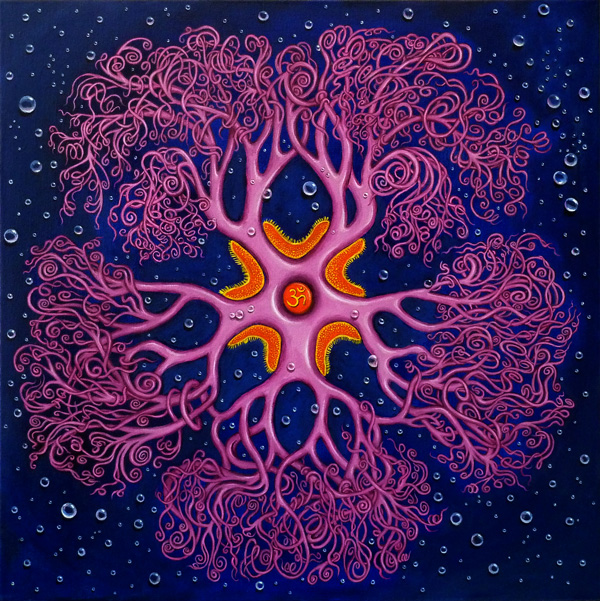
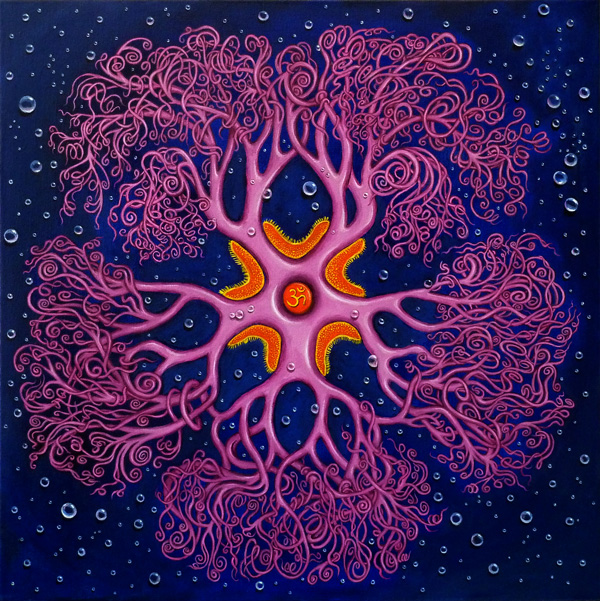
But the animal that impressed me most during the visit was something I didn’t even know existed before I was staring at a dried specimen. The Gorgonocephalus is a starfish-like radially symmetrical creature with blooming curly tentacles at the end of each arm that are used for locomotion. Even dried, brittle, and colorless, it had a beautiful elegance that captivated me, so I set about painting it. I’m eternally grateful to Sebastian for his generosity in taking me on multiple tours through the museum, and will remain indebted to him for introducing me to this wonderful creature.

I didn’t really take many liberties with the form of the creature. I chose to paint it purple because I liked the way the purple in “Jellin” had stood out against the deep blue background. It was immensely time consuming to paint the tentacles in the meticulous detail that I chose, but once I started I had no option but to go through with it. Not quite sure what inspired me to put an “Om” symbol over the mouth – it just seemed to work there.
Similar Posts

  • Red Waltz

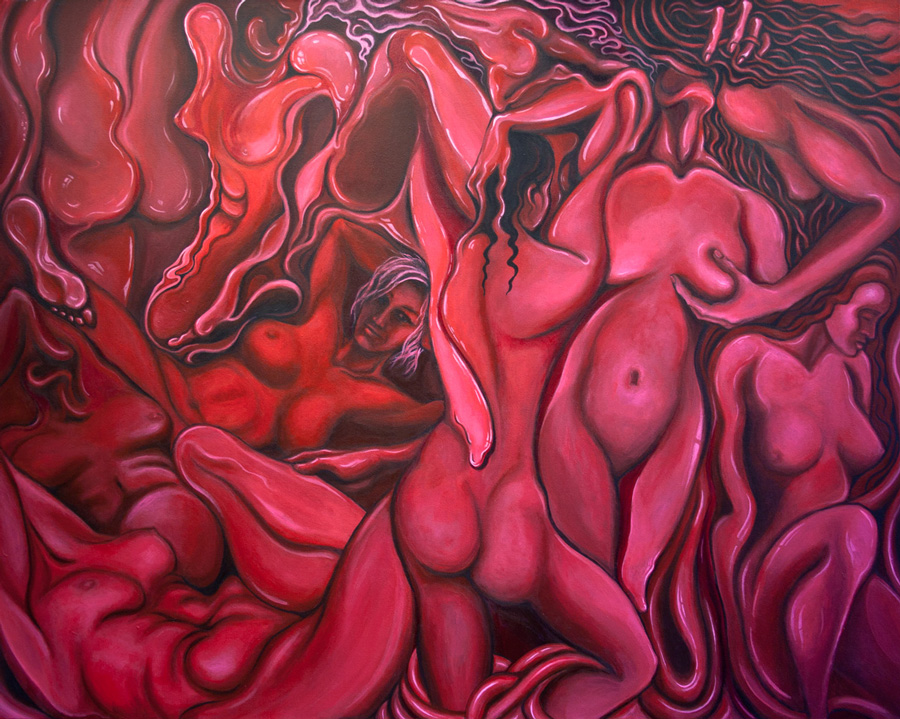
    Been having a bit of an obsession with red recently. After painting a wall in my apartment burgundy, I had a bunch of leftover paint, so that’s how I began this canvas. It’s a big one – 5 feet long, 4 feet high.

    It’s been a few years since I painted Sensuality and I’ve always wanted to create more works in that slimy soft style. That was the original idea with this one but I decided to go with red instead of orange as the base. The female form in Sensuality emerged after an improvisation, but for this one I decided to chalk some in from the start and work around them. As you can see from the photos I took as it was progressing, at the start the figures were much more loosely defined and distorted. But as the composition started to fill in, I began to have more fun with creating better defined female forms so I just went with it. The painting ended up racier that I had originally intended too…not that that’s a bad thing.

    A couple more things I’d like to say about this painting. First of all, I’m not 100% sure that I’m done. It could be complete as it is now, but it might need a couple of finishing touches still. I like the monochrome red, but it’s hard not to feel like it’s lacking something. Also I cannot for the life of me figure out how to capture the richness of the color on film. I’ve tried a bunch of different cameras and settings and different types of lighting, but I still haven’t been able to reproduce the colors to my liking. I’ve had the same trouble with a couple of other painting where red is dominant – most notably Lasya. If anyone has any ideas, please let me know.

  • The Dawning Age of Reason

    The-Dawning-Age-Of-Reason

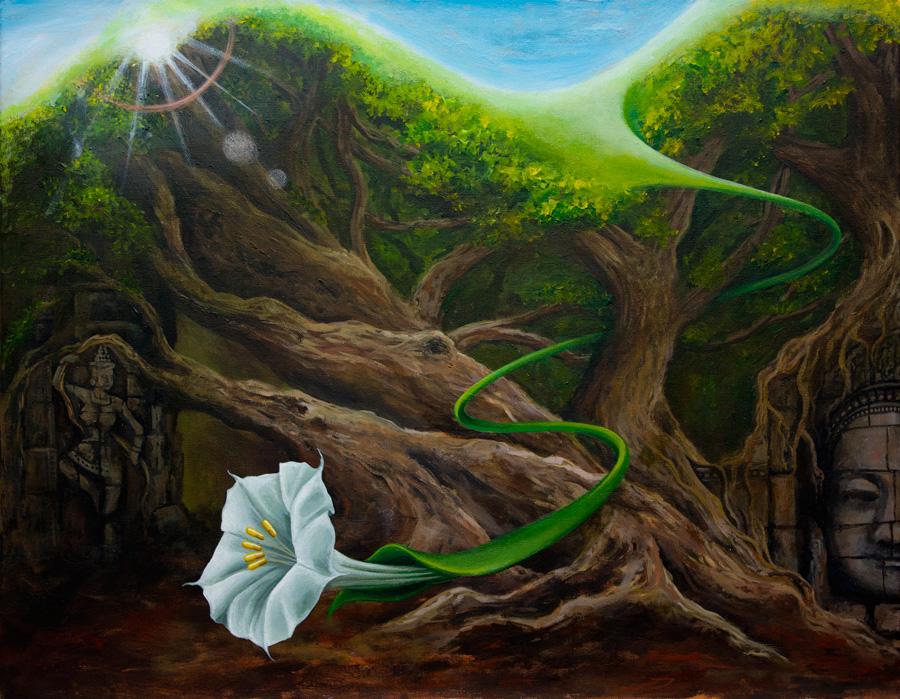
    An explosion of light comes crackling through the branches as a trumpet Lilly heralds the dawning of a new age.  Below, crumbling idols are the vestiges of the old, and above, the trees’ vibrant greens are the fountains of the new.  Yet while the reason of the new age supersedes the superstition of the old, it is built on what came before.  Roots tread a fine line between absorbing age-old wisdom from the ancient rocks that they depend on for support, and breaking apart their decaying remnants.  The flower carries within it a potent symbol of the new age, its stamens poised to pollinate the world with the new science of medicine that has doubled lifespans within merely a handful of generations.

    As with much of my work, the inspiration for this narrative didn’t emerge until very late in its evolution.  A forest scene emerged after a quick improvisation, and as I teased out some gnarly tree trunks, I felt that ancient temples were an appropriate addition to the scene.

    The sky over the canopy started out orange, but it was too jarring for me, so it became a calmer blue.  The blue inspired the sunlight and the lens flare, and very soon a long green vine twisted its way out of the canopy and into the bell of a flower.

    It wasn’t until I added the stamens, which turned to yellow pills, that the inspiration for the name and the theme of this piece struck me.  Maybe it was in my subconscious all along, but it didn’t fully materialize until the end.

    In many ways the revolution of evidence-based medicine is the age of reason’s greatest accomplishment – underscored by the fact that if I’d lived in the era before it, I’d either be dead or very close to dying by this point in my life.

  • Toccata

    Toccata is one of my earliest works, and also one of the largest canvases I have ever attempted. It was started and completed on a dreary winter Saturday in 1994 and hasn’t really been touched much since. While I love it conceptually, I’ve never been completely satisfied with the execution of it, and to be honest I’m a bit embarrassed by how raw it is – never had a chance to refine or clean up the rough edges at the time, and it’s a bit too late now.

    Toccata was an attempt to paint a piece of music – a seven and a half minute instrumental by the same name based on the Fourth Movement of Alberto Ginastera’s 1st Piano Concerto, arranged by Keith Emerson and performed by Emerson Lake and Palmer. It’s a very complex, meandering, experimental track – packed with synthesized sounds and loops, morphing from dramatically violent passages to calm spacey sections and even features an epic drum solo that starts with gongs, tubular bells and timpani and ends with electronic drum loops. I listened to it on repeat while painting until the batteries ran out on my discman, then took a break for lunch, bought new batteries, and went back to listening to it until I was done late at night. Needless to say, I haven’t listened to it much since then. I started with a very violent and explosive underpainting – in synch with the music. As I refined it, I inserted elements that I was hearing. I wanted it to have depth and deep space, and to invoke sounds in the ears of the viewer. I did some questionable things like stick pieces of dried paint from the inside of paint cans to the canvas. I didn’t stop to think much – the music was too overbearing to allow for it. When I left that evening I didn’t return to the studio until Monday afternoon, when it was to be critiqued by the class.

    Toccata clips by khusroks

    When I saw it again on Monday, I remember being impressed but at the same time disappointed by what I had created. The critique was particularly contentious. I was attacked on the grounds that a depiction of music shouldn’t have recognizable forms (clock, bell, etc.) but should be more abstract – indeed most people who tackled that assignment produced works similar to Kandinski’s compositions. I countered that recognizable sounds instantly conjure up recognizable forms (e.g. the sound of a dog barking makes you think of a dog) and my piece of music – a short section of which was played for the class – was rife with recognizable sounds that ended up being depicted on the canvas.  I don’t think the consensus was with me and I remember leaving that critique feeling like I might just dump it or start from scratch and paint over it. I’m glad I didn’t.

    Regardless of its flaws, I do think Toccata is a particularly affecting piece of mine. There’s no doubt that its size has an impact on the viewer, and it’s probably the piece that I’ve heard more people cite as their favorite of my works.

  • Chamber 51

    Here’s a painting seventeen years in the making!

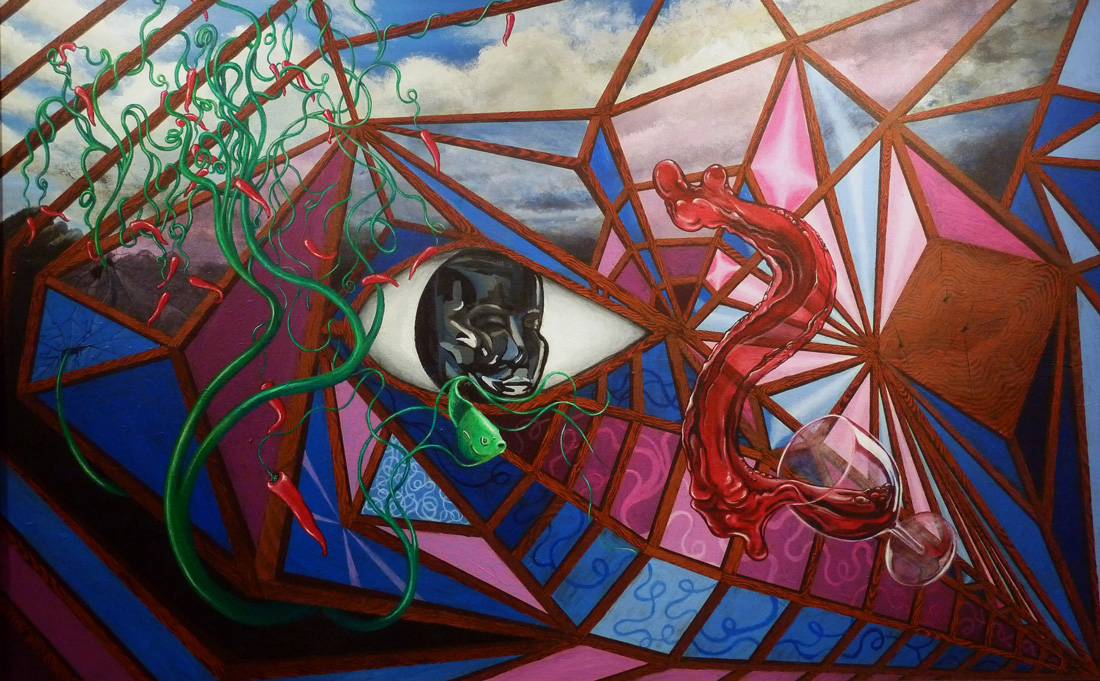
    I stretched the canvas myself in 1995 and created what could only be described as a juvenile homage to Dali’s landscapes. It really was quite awful and I only saved it because it seemed like a waste to throw away such a massive canvas. In the early 2000s, I decided to start working on it again. The photo on the right was taken just before I started, so you can see what it looked like originally (and you can see my cat peeking out from behind it). I blanked out vast sections of it, kept some parts like the black mask, a couple of fish, the sky and the stereo, then abandoned it.

    In late 2010 I started working on it again. This time I decided I needed to break it up into sections, so I used masking tape and created random sections. The sections ended up looking like a spider web. The mask became an eye. Then I shelved it again. Wish I had a photo of it from this time but I can’t find any.

    Finally in late 2011, I decided to get serious about completing it. The spider web thing wasn’t really working, and at the time I was trying to pick out wood flooring, so I had wood grain on my mind and wanted to paint wood, so I turned the web into wood. I had also just finished painting hundreds of tentacles for Gorgonomcephalus, so some tentacles were laid down on the left side, which eventually turned green and became vines. I wasn’t really feeling up for painting leaves even though the vines needed something. The painting seemed to missing reds – I wanted deep, bright reds, so I added the chillies, still avoiding having to paint leaves. I liked the way the red chillies looked, started craving more red. Poured myself a glass of wine while I sat there trying to figure out how to add more red…

    So the painting is finally done – many disparate elements, not really sure if it “works” to be honest, but there it is. I was struggling with a name for it so I asked my friends to suggest one. My friend Arish Dastur came up with the name “Chamber 51” – I really like the name because it doesn’t try to reference anything in the painting or tie anything together. It just adds another layer to it – pretty appropriate for a painting that just grew out of disparate ideas. Also makes me think I may be painting a few other chambers soon.

  • Art and Censorship: Paul Simon vs. Artists Against Apartheid

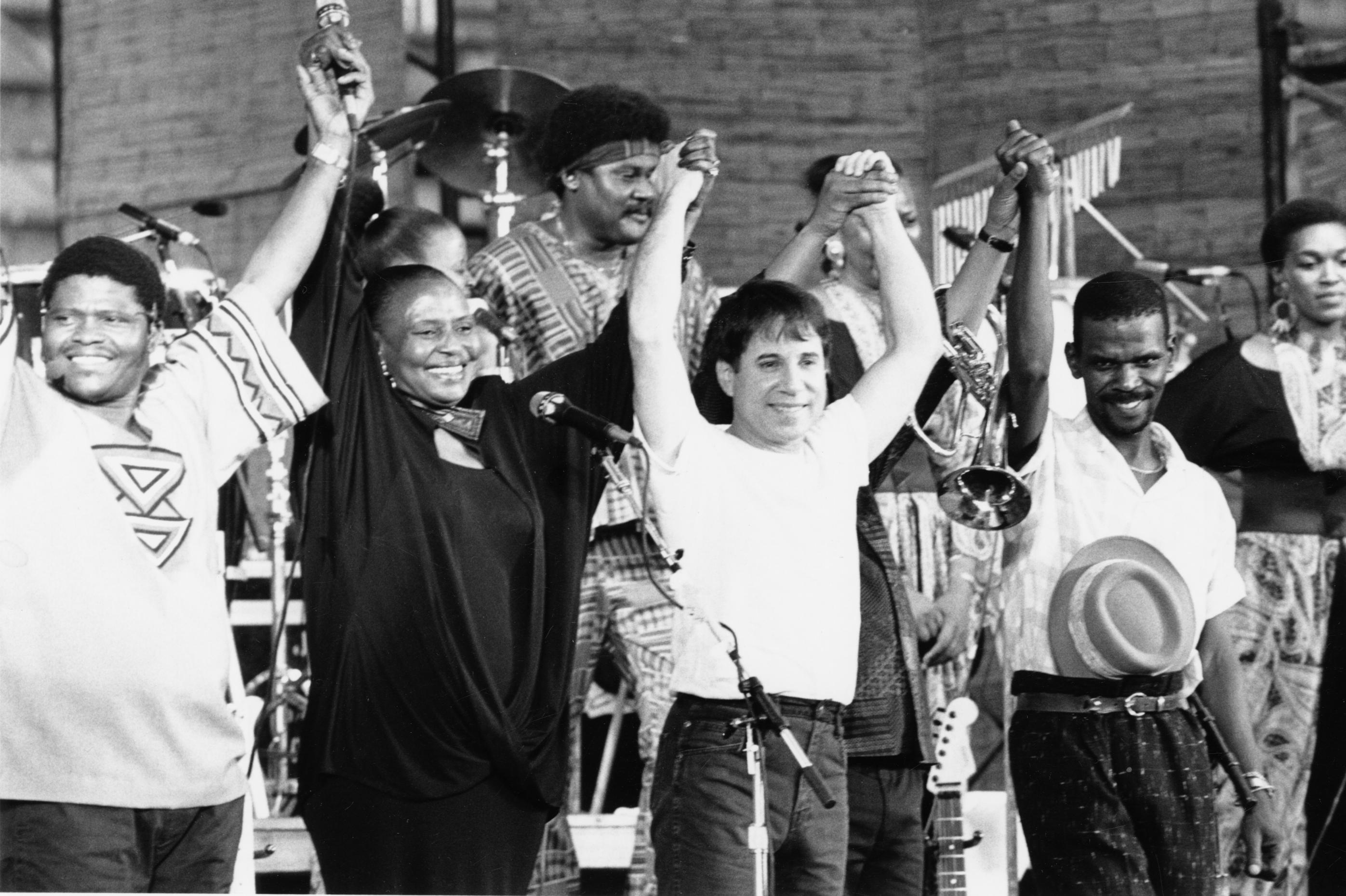
    Under African Skies, Joe Berlinger’s documentary about the making of Paul Simon’s Graceland album, opened in New York and Los Angeles this week, and I was lucky enough to get to see it twice. The film is exhilarating and heartwarming as it explores the cultural phenomenon of one of the greatest albums ever made, and the stories of the South African musicians who played both on the album and the world tour that followed. Even if it merely focused on the music, it would still blow away any documentary about the making of an album, but it also has another, more potent, layer. It is entirely framed within a political argument that was seething at the time – an argument that as a child of the 80s, I was blissfully unaware of when I first grew to love the music on the record. I want to break with my usual musings on my own art to discuss my thoughts on the film in this post. Warning: spoilers below, if you have not seen the film please, please, go see it – it is absolutely wonderful.

    In the mid-80s, Paul Simon became obsessed with South African music, but rather than round up accomplished musicians in New York to replicate the sound for his new album, he decided to travel to South Africa to collaborate with the masters. The problem was that he did this in violation of the United Nations’ boycott of South Africa’s apartheid government, and at a particularly inopportune moment for the liberation struggle. The documentary is speckled with images and videos of protests and furious confrontations that arose after Graceland’s release, and its backdrop is a tense discussion between Paul Simon and Dali Tambo, the founder of Artists Against Apartheid, which runs throughout the film.

    During the film, arguments are made on both sides. Dali Tambo and Wally Serote continually reiterate how problematic it was for Paul Simon to flagrantly violate the cultural boycott, and how important it was to keep the racist regime isolated. Simon’s camp makes the argument that as artists they should have been allowed a pass, that he meant no harm, and that it was a wonderful life-changing experience for everyone involved in the project – a point that is hammered into the audience through intensely emotional scenes of oppressed musicians finally tasting freedom. Even though the film is primarily about celebrating the music that resulted from the collaboration, the film tries to be as neutral as possible in its presentation of the debate. Though it is abundantly clear that even 25 years later, Simon remains deeply hurt by the criticism, the film concludes with a “reconciliation” – a handshake and hug – where Paul Simon acknowledges his mistakes and apologizes for any harm he caused, and Dali Tambo professes that he and his organization hold no grudge, the music was brilliant, and that Simon was merely caught up in the whirlpool of a political struggle. The viewer is left without a clear resolution or opinion and the general conclusion is that it remains a complex issue with no clear correct answer…he was probably wrong to do it, but we’re glad he did because the music was so good.

    However, I don’t think of this as a grey issue where the truth lies somewhere in between. Even though Paul Simon didn’t set out to specifically violate the boycott, I think he was right to do what he did, and wrong to apologize for it – mainly because I question the idea of a cultural boycott in the first place. This is something that the film doesn’t do – it merely dances around whether Simon was right to break it and the implications of making an exception for him. I’m of the opinion that the cultural boycott was not just wrong, but misguided and counter-productive.

    History is brimming with examples of art making a difference in political struggles. Art is and will always be one of the most potent forces that drives people to change. It moves the human soul in a deeper and more profound way than any rational argument has a hope of doing. From Beaumarchais’ Marriage of Figaro to Stowe’s Uncle Tom to Bob Marley’s anthems, art has changed opinions and incited and inspired protest. Could you even imagine the anti-Vietnam-war movement without the soundtrack of the 60s to fan the flames? While Ellen DeGeneres would probably take issue with Joe Biden’s recent quip about Will and Grace’s supreme influence on public opinion about gay people, the point remains valid. Art inspires change. To censor your most powerful weapon in a protest is to shoot yourself in the foot – and that’s what the ANC and Artist Against Apartheid did. Isolating a morally corrupt regime is effective – there is no doubt about that. But while a trade boycott may hurt the regime as it is intended, a cultural boycott hurts the liberation movement because it prevents the most influential and moving voices from making themselves heard to a wider audience, with the result that it actually shields the regime from people who would have been moved to support the movement in other corners of the world.

    Paul Simon’s visit and subsequent world tour were subjected to intense criticism and vitriol because the dogma of a cultural boycott went unquestioned. Since the heavyweights of the liberation struggle decreed that art should be treated no different from trade in the isolation of the regime, any violation was perceived as pro-apartheid. But the ANC could not possibly have been ignorant of the fact that within South Africa, artists were integral to the anti-apartheid movement. Throughout the history of segregation, protest music gave black South Africans hope and courage to continue and eventually win the fight – which is what makes the restriction on their creative expression even more damning. Artist Against Apartheid and the ANC should accept the blame, not just for the harm their cultural boycott did to the muted artists of South Africa, but for making it harder for their cause to garner support all over the world. Thankfully, an unlikely and unwilling revolutionary emerged in a diminutive New Yorker. Paul Simon, who started out largely apathetic to the cause and unconcerned with the struggle, eventually ended up taking grave personal risks for his art and on the behalf of the musicians who helped him achieve the zenith of his career. He confronted the boycott, and won. And the world is a better place because of Graceland.

  • Lasya

    “Lasya” is the creation dance performed by the Hindu god Shiva in his depiction as Natraj. The inspiration to meld Indian and Spanish dance came from my sister Behnaz, who is a dancer. She’s been performing Flamenco for many years now and some time ago she had explained to me how it had originated from Indian classical music and dance. I thought a many-armed flamenco dancer in the place of a Natraj would make a good image.

    Lasya is one of my few “planned” paintings – the idea hit me when I was trying to come up with an appropriate subject for a rich red background that I had already laid down on canvas. The dancer is modeled after my sister based on a few performances that I’ve witnessed.